
Liver fat fraction is commonly measured when people are evaluating or monitoring fatty liver disease, now often called MASLD. Older reports and papers may use NAFLD. The inflammatory form may be called MASH or NASH.
TraceOrg helps organize abdominal MRI studies into a liver fat fraction report for research workflows and expert review. The report can show the selected sequence, liver fat fraction values, sequence quality notes, and a liver-only fat fraction map snapshot.
Why People Measure Liver Fat
People may be interested in liver fat fraction when there is suspected fatty liver, obesity, type 2 diabetes, prediabetes, high triglycerides, metabolic syndrome, elevated liver enzymes, or follow-up after weight loss, bariatric surgery, lifestyle change, or metabolic medications such as GLP-1-based therapy.
Many patients and researchers now ask about liver fat in the setting of GLP-1 receptor agonists or related weight-loss medications, such as semaglutide or tirzepatide. TraceOrg does not recommend, prescribe, or monitor medication safety, but MRI-PDFF can be useful for expert-supervised before-and-after imaging review.
What Is MRI-PDFF?
MRI-PDFF means magnetic resonance imaging proton density fat fraction. It estimates how much of the measured liver signal comes from fat compared with fat plus water.
The RSNA Quantitative Imaging Biomarkers Alliance, or QIBA, describes MRI-PDFF as a quantitative imaging biomarker for hepatic fat content. For liver applications, the physiologic range of interest is usually 0% to 50%.
RSNA/QIBA Liver Fat Reference Bands
TraceOrg uses RSNA/QIBA-style MRI-PDFF reference bands as an interpretation guide:
Less than 5%: within normal or no steatosis range.
5% to less than 15%: mild steatosis range.
15% to less than 25%: moderate steatosis range.
25% or higher: severe steatosis range.
These are reference bands, not a diagnosis. Values near 5% should be interpreted carefully because published thresholds vary slightly by study, scanner, population, and analysis method.
What MRI Images to Upload
For liver fat fraction analysis, upload the full abdominal MRI study when possible, not only a screenshot, JPEG/PNG export, or one isolated slice. TraceOrg can then look across the study and choose the best available series.
Scanner-generated PDFF or fat-fraction maps.
Multi-echo Dixon or quantitative Dixon series, such as IDEAL-IQ, mDIXON Quant, qDixon, LiverLab, or similar acquisitions.
Matched Dixon water and fat images.
In-phase and opposed-phase images only as a lower-confidence fallback.
Avoid localizer, diffusion/DWI, MRCP, heavily motion-degraded series, screenshots, JPEG/PNG exports, or isolated single slices for fat fraction measurement.
For step-by-step upload instructions, see How to Upload Your Images to TraceOrg.
Why MRI Sequence Quality Matters
Not every abdominal MRI series can measure liver fat reliably. TraceOrg first looks for scanner-generated PDFF or quantitative fat-fraction maps, such as multi-echo Dixon, IDEAL-IQ, mDIXON Quant, qDixon, LiverLab, or similar acquisitions.
If a direct PDFF map is not available, TraceOrg can use a matched Dixon water/fat pair: fat / (water + fat) x 100.
If only in-phase and opposed-phase images are available, TraceOrg may generate a lower-confidence fallback estimate: (in-phase - opposed-phase) / (2 x in-phase) x 100.
QIBA notes that conventional two-echo in-phase/opposed-phase methods may be biased because they do not fully correct for effects such as R2* decay and multi-peak fat signals. TraceOrg therefore labels this as a fallback estimate rather than a scanner-grade PDFF result.
What TraceOrg Reports
Median and mean liver fat fraction.
Standard deviation and value quality checks.
Selected MRI series and method.
Sequence QA showing selected and rejected series.
Vessel and cyst exclusion where labels are available.
A liver-only fat fraction map snapshot.
Example report figures
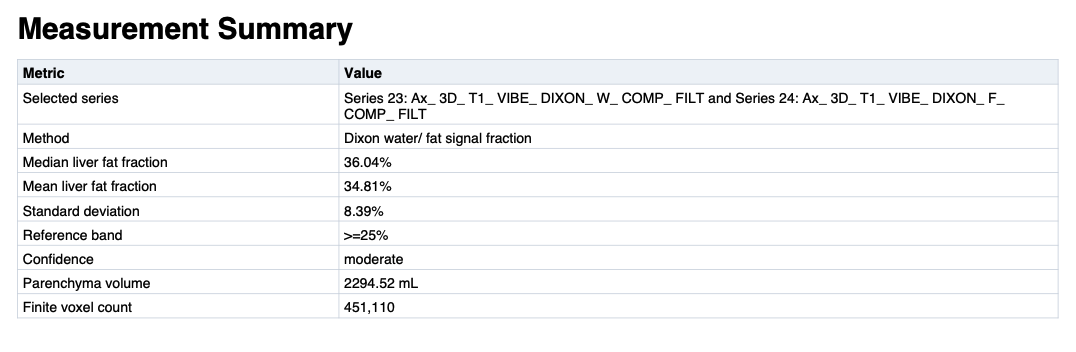
Example measurement summary from a TraceOrg liver fat fraction report. The median liver fat fraction is the main value to read first; method and confidence explain how the value was generated.
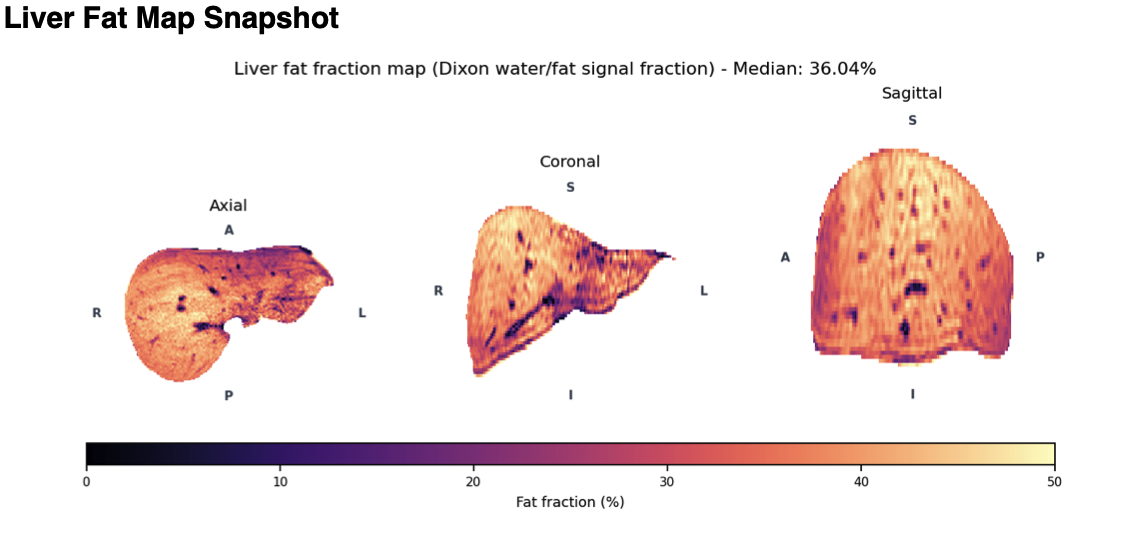
Example liver-only fat fraction map snapshot. Outside-liver pixels are masked, and the color bar shows fat fraction percentage.
The snapshot shows the fat fraction map itself, not the water image. Outside-liver pixels are masked out and the map is zoomed to the liver region.
How to Read the Result
Start with the median liver fat fraction. A result below 5% is generally within the normal or no-steatosis reference range when measured by a qualified MRI-PDFF sequence. Results from 5% to less than 15%, 15% to less than 25%, and 25% or higher fall into mild, moderate, and severe steatosis reference bands.
These values do not diagnose MASH/NASH, fibrosis, cirrhosis, or liver inflammation. They should be interpreted with liver enzymes, metabolic risk factors, alcohol history, medications, fibrosis assessment, and expert review.